How to Pick the Right Inflatable Size for Your Backyard Before You Book
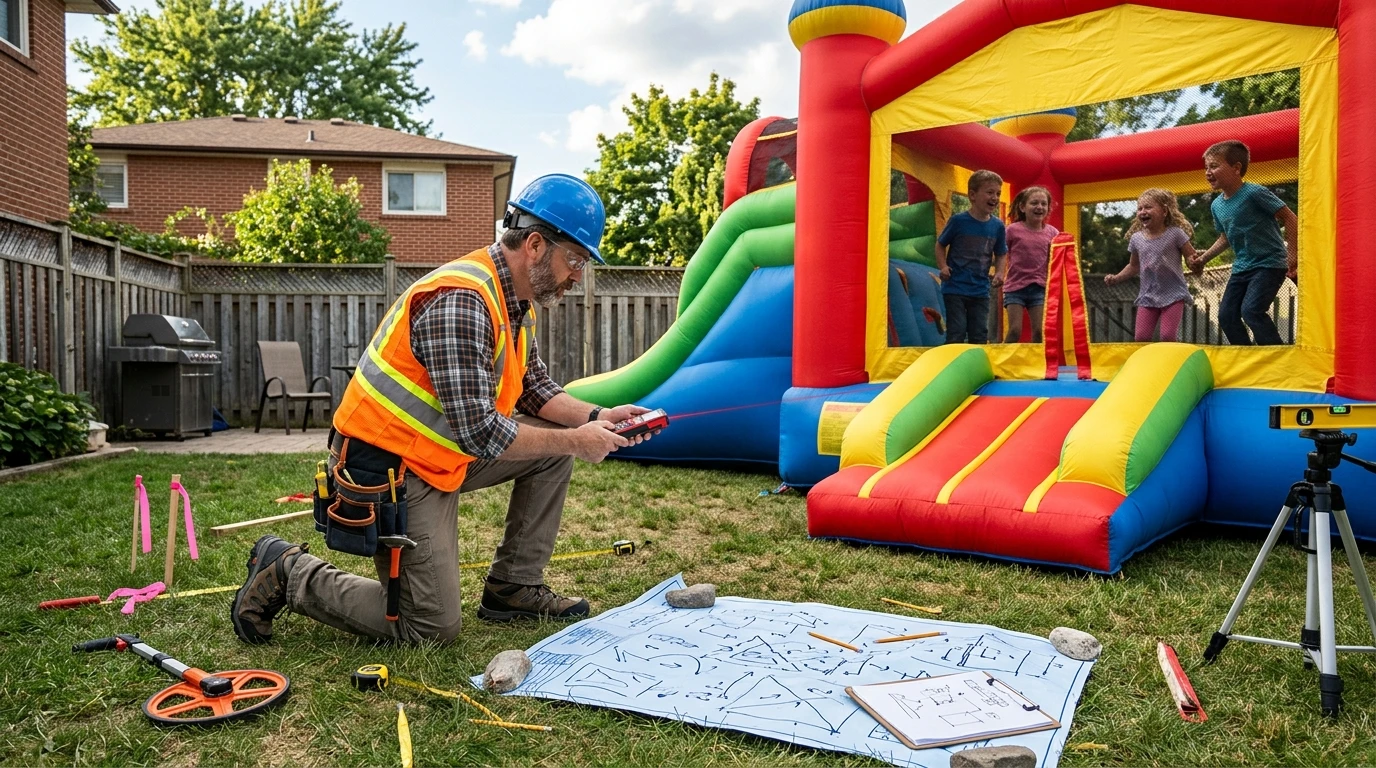
I get the same phone call almost every week during party season. A mom picks up, describes her backyard in Pierrefonds or Kirkland, and ends with "but I don't think it's big enough." Nine times out of ten, it is. She's just measuring the wrong thing.
Most parents look at their whole yard: the flower beds, the shed, the kids' swing set, the patio furniture, and then mentally shrink the space down to whatever's left over. But a bounce house doesn't need your whole yard. It needs one flat, open rectangle, and once you actually go outside with a tape measure, that rectangle is almost always bigger than you think.
So before you talk yourself out of booking a bounce house rental in Montreal because your yard "looks small," let's measure it properly. It takes about five minutes, and I'll walk you through exactly what to check.
Measure the usable rectangle, not the whole yard
Walk to the spot where you'd want the inflatable to go and ignore the rest of the yard for a second. Now find the largest flat, open rectangle you can trace in that one area: no trees overhead, no slope, no in-ground sprinkler heads poking up, no low-hanging deck or pergola in the way.
Here's the part people skip: measure from fence to fence, or from the house to the back fence, in a straight line. Use your phone's measuring app if you don't have a tape measure handy, or just pace it out heel-to-toe (an adult stride is roughly 2.5 feet, so ten strides gets you close to 25 feet). Write down two numbers, width and depth, for that flat rectangle.
While you're out there, look up too. Overhead branches, hydro wires, and roof eaves matter just as much as ground space. Most standard bounce houses need about 13 to 15 feet of vertical clearance. Bigger combo units with a slide attached, or tall obstacle courses, can need 18 feet or more straight up. If a maple tree hangs over the spot you had in mind, that rules out the tall stuff, but it doesn't rule out everything. More on that below.
Clearance is the number that actually matters
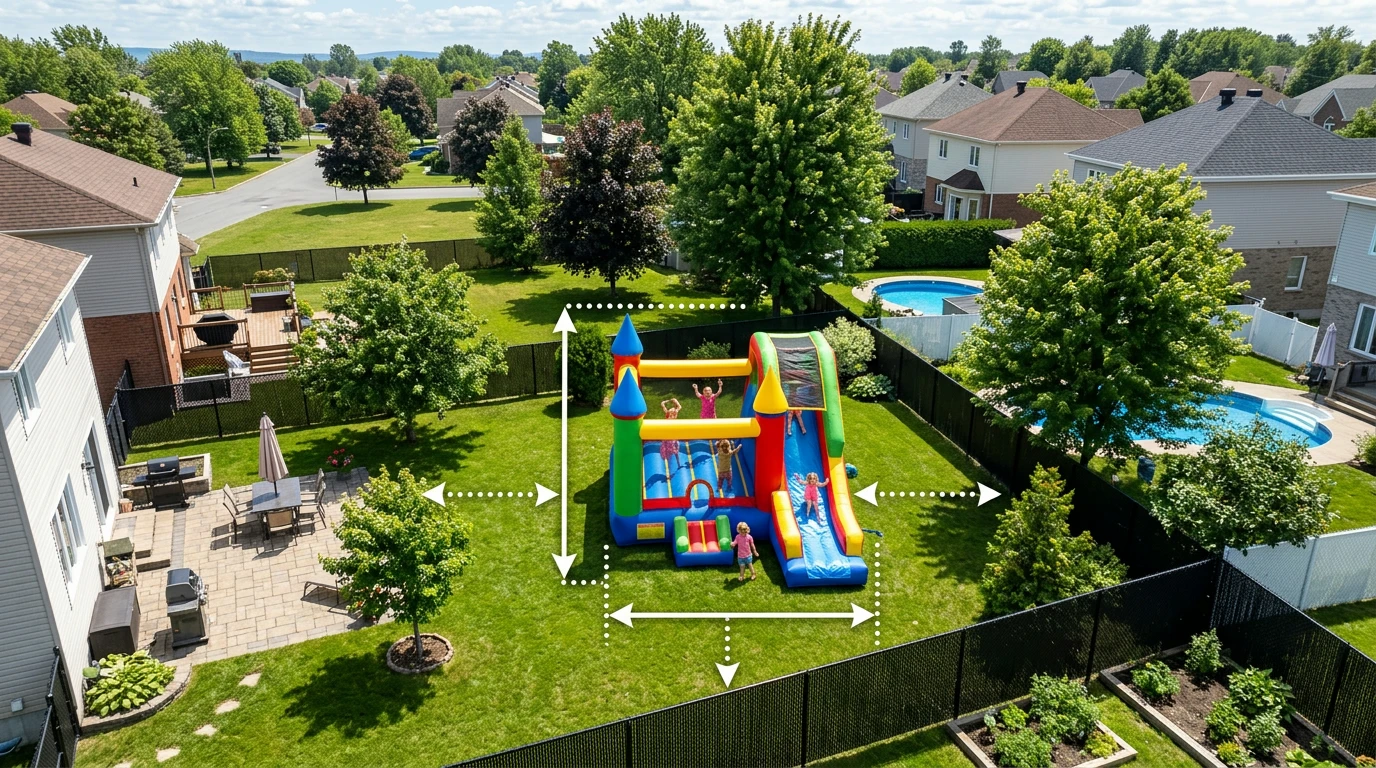
This is the detail that trips people up online. A lot of rental sites list only the box dimensions of the inflatable itself, say "15 by 15 feet," without mentioning that you also need open air around it for safe entry, exit, and anchoring. That's how parents end up thinking a 15-by-15 unit only needs a 15-by-15 patch of grass, when in practice the setup area ends up closer to 20 by 20 feet once that extra room is added in.
We do it the other way around, on purpose, to make this simpler for you. When we tell you a spot needs to be, say, 20 by 20 feet, that number already has the clearance built in. The inflatable itself is actually smaller than the figure we give you. We'd rather hand you one number to check against your yard than make you do extra math on top of a spec sheet. If a quote says 4 by 4 meters, plan for exactly that, nothing more. The buffer's already baked in.
That exit zone is the detail I care about most, honestly. A kid comes down a slide with real speed, and where they land needs to be open, flat, and away from a fence, a patio edge, or a garden bed. I've seen backyards with "enough space" for the inflatable's footprint but not enough room past the slide exit, and that's exactly where kids get scraped knees. When you're measuring, don't just check if the box fits. Check where the last few feet of momentum go.
If you want a deeper breakdown of sizing by unit type, this guide has a solid table of dimensions for combos and slides that lines up with general clearance standards across the industry, though when you get a quote from us, that math is already done for you.
Quick clearance guide
- Standard bounce house: roughly 13-15 ft height; the ground space we quote already includes safe clearance on all sides
- Bounce and slide combo: taller and longer; our quoted footprint already accounts for the extra room these need
- Obstacle course: long and narrow; the space we quote already includes the runway and side clearance
- Overhead: check for branches, wires, and roof lines along the whole length of the unit, not just above the middle
- Underfoot: flat grass works best for us to anchor safely, a flat driveway can work too, but slopes and sprinkler heads don't
Anchoring is not optional, and it's not something you DIY
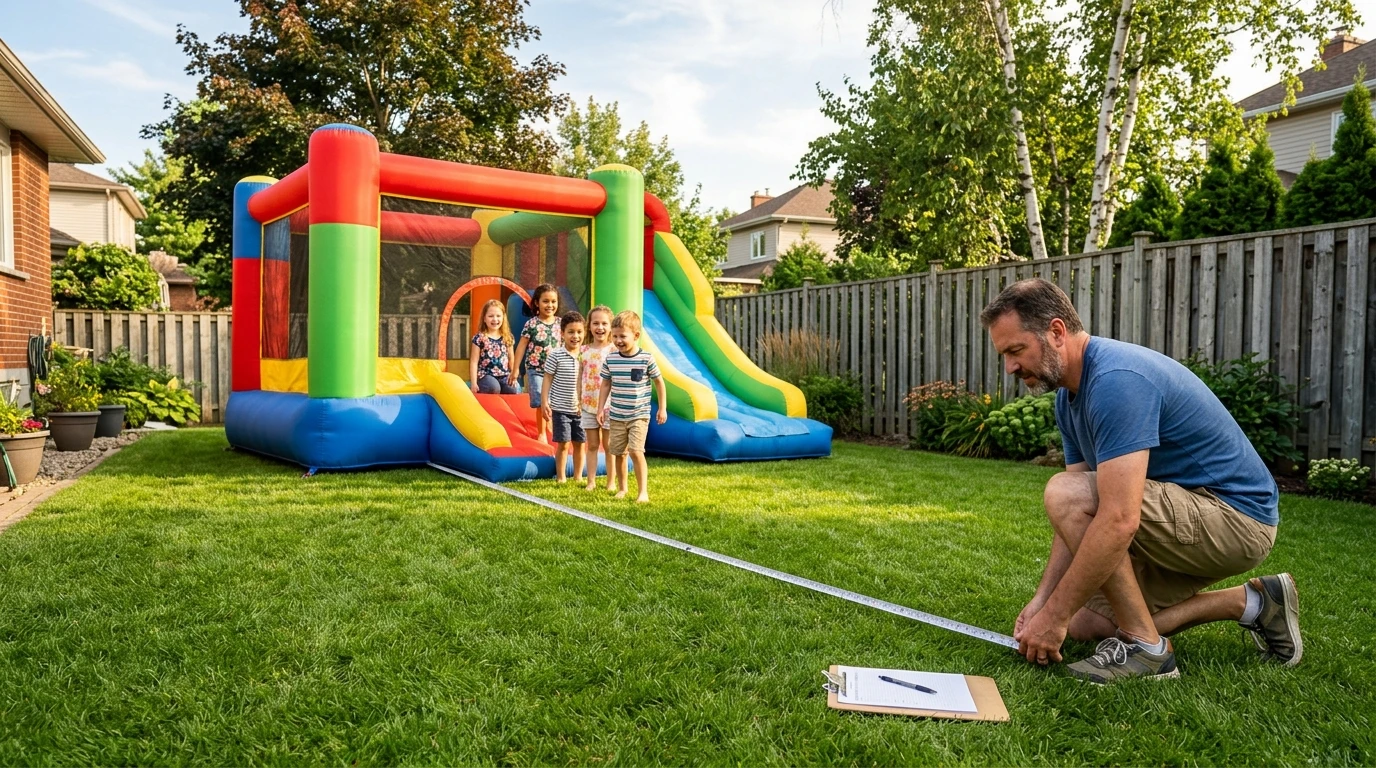
One reason we ask for real measurements before setup day, instead of just showing up and hoping for the best, is that every inflatable has to be properly anchored. Our go-to method is staking directly into the grass. It holds well and it's gentler on the unit than anchoring into pavement or gravel. On windy days, or for bigger units like combos and slides, we add weighted sandbags at each anchor point on top of the stakes, for extra hold.
Depending on the unit, manufacturers recommend anchor weights ranging from about 75 pounds for smaller bounce-type units up to 500 pounds for larger slide-type units, at each anchor point. That's not something you eyeball. The Consumer Product Safety Commission's safety bulletin on inflatables covers this in more depth if you're curious, and it's part of why we always send trained staff to set up rather than dropping off a box and driving away. Ground type and wind conditions change what anchoring looks like on your specific lawn, and that's worth getting right before thirty kids show up.
If you want more on what a properly run setup looks like on the day, we've written about it in our rundown of what to check before booking a bounce house, and in our safety tips post if you want the full picture before the big day.
When your yard really is tight, here's what still works
Some yards genuinely don't have a 20-by-20 flat rectangle. Rowhouses in NDG, condo courtyards, backyards eaten up by a pool or a deck, it happens, especially across the West Island where lot sizes vary a lot from street to street. If that's you, here's the good news: "too small for a bounce house" doesn't mean "too small for a great party."
Our minipod is built exactly for this. It's a compact inflatable unit that fits into a fraction of the footprint a full bounce house needs, and kids still get a full afternoon of jumping and climbing out of it. We also bring lawn games rental Montreal families love for tighter spaces: giant connect four, ladder toss, cornhole, ring toss setups that need almost no clearance and work just as well on a small patio as on a big lawn. Pair two or three of these together and you'll have kids busy the entire party without needing a single square foot of dedicated bounce space.
Interactive sensor-based inflatables are another option worth knowing about. These are the games where kids throw balls or beanbags at a target and a scoreboard tracks the hits in real time. They take up far less ground space than a bounce house but keep a group of kids just as engaged, sometimes more, thanks to the competitive element. We break down how these compare to a traditional bounce house or obstacle course in this post on choosing between the three, worth a read if you're on the fence about what fits your space and your kid's age group.
We've also seen carnival-style games save small yards more than once: ring toss, mini basketball, balloon darts all scale down to fit almost any corner of a yard. If you want ideas for mixing DIY games with a rented setup, this list of backyard carnival games is a good starting point.
The checklist to bring outside with you
Before you call us, grab five minutes and check these off:
- Measured the widest flat, open rectangle in your yard (width x depth)
- Checked overhead for branches, wires, or roof overhang along the full length
- Confirmed the ground is flat grass, artificial turf, or flat pavement (not sloped, not gravel), since grass is what we anchor into best
- Noted where a slide exit or bounce entrance would land, and made sure that spot is clear too
- Checked for a power outlet within about 100 feet, most units run on a standard blower
- Took two or three photos of the space from different angles
That last one is the shortcut that saves everyone time. Send us those photos along with your two measurements and we'll tell you exactly what fits. No guessing, no upselling you into something too big for the space.
We confirm the fit before you pay for anything
This is genuinely part of how we quote every job, whether it's a small birthday for six kids or a backyard party that somehow grew to 37 kids (yes, that really happened, and it went great because we sized the games to the yard, not the guest list). When you reach out for kids birthday party rentals Montreal families trust us for, we ask for your yard dimensions and a couple of photos before we ever confirm a booking. If a bounce house won't work, we'll say so, and we'll suggest something that will, instead of showing up on the day and trying to force a unit into a space it doesn't fit.
We cover inflatable rentals West Island Montreal families rely on and deliver across the greater Montreal area, and in six years of doing this, I can count on one hand the number of yards we genuinely couldn't work with. Usually there's a minipod, a lawn game set, or a smaller unit that turns "my yard's too small" into a great afternoon anyway.
So don't skip booking just because you're not sure. Grab your tape measure, snap a few photos, and send them our way. We'll tell you straight what fits, and if the bounce house you had in mind needs a little more room than you've got, we'll have three other ideas ready before you even ask.
FAQ
How much space does a bounce house actually need?
The number we quote you already includes the clearance needed for safe entry, exit, and anchoring, so you just need to match your yard to that one figure. As a general rule across the industry, a 15-by-15-foot unit typically needs about a 20-by-20-foot flat, open area once clearance is factored in, but with us that math is already done for you.
How do I measure my yard without a tape measure?
Use your phone's measuring app, or pace it out heel-to-toe since an adult stride is roughly 2.5 feet. Measure the widest flat, open rectangle in a straight line, from fence to fence or house to fence.
How much overhead clearance do I need for trees or wires?
Standard bounce houses need about 13 to 15 feet of vertical clearance, while bigger combo units with slides or tall obstacle courses can need 18 feet or more. Check for branches, wires, and roof eaves along the entire length of the unit, not just above the middle.
What if my yard is too small for a bounce house?
Options like the minipod, lawn games, and interactive sensor-based inflatables need far less footprint and still keep kids entertained all afternoon. In six years of doing this, it's rare to find a yard that can't work with something.
Why does the exit zone matter so much for slides?
Kids come down slides with real speed, so the landing area needs to be open, flat, and away from fences, patios, or garden beds. A yard can have "enough space" for the inflatable's footprint but not enough room past the slide exit, which is where scraped knees happen.
How do you anchor the inflatable safely?
We stake directly into the grass, which holds well and protects both your lawn and the unit. For larger units like combos and slides, or on windy days, we add weighted sandbags at each anchor point on top of the stakes for extra security.
What information do you need before confirming a booking?
Send your two yard measurements (width and depth) and a couple of photos from different angles, and the team will tell you exactly what fits. They confirm the fit before any booking is locked in, no guessing involved.