Bounce House vs. Obstacle Course vs. Interactive Inflatable: Which One Is Right for Your Party?
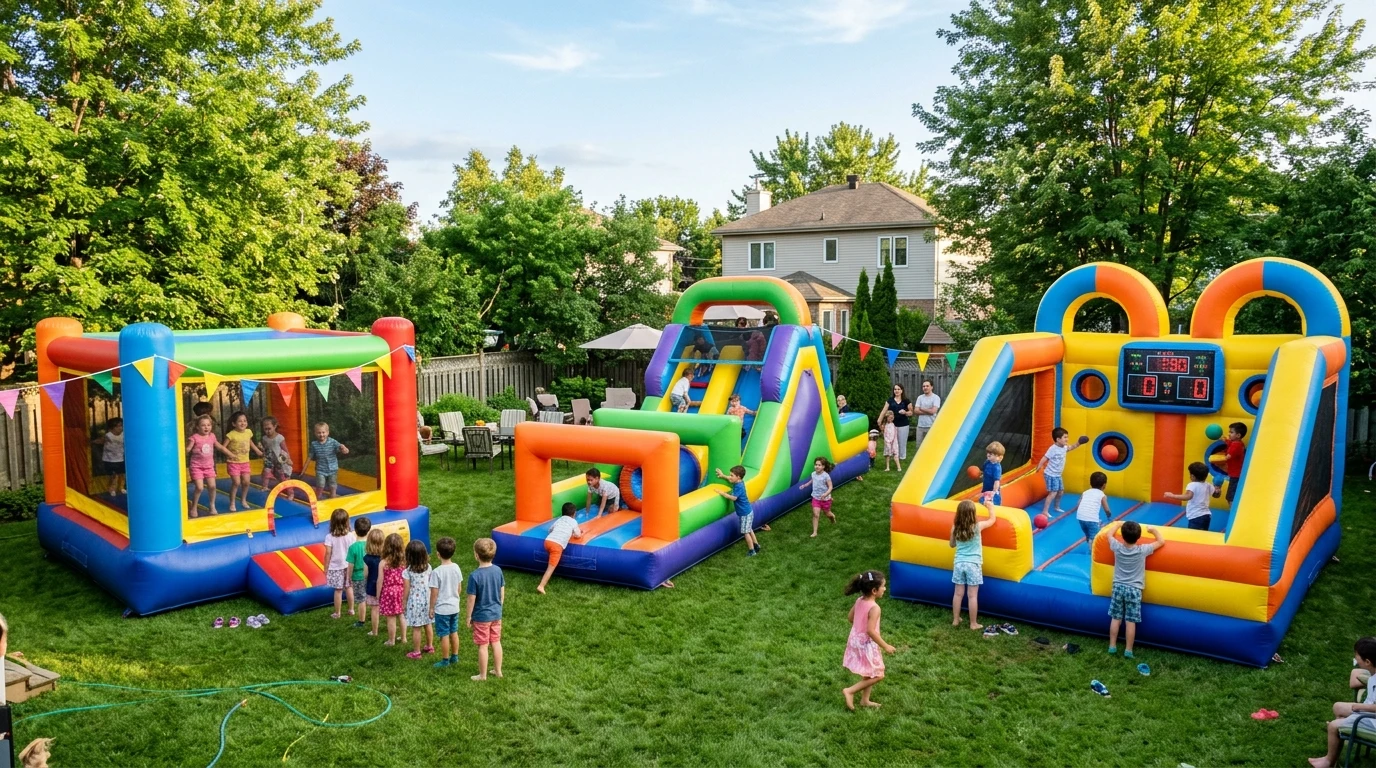
Most parents type "bouncy castle rental Montreal" into Google, click the first result, and book whatever comes up. That works fine, until the kids are bored twenty minutes in because the inflatable was built for five-year-olds and half the guests are nine. Picking the right type of inflatable isn't complicated, but it does matter. Here's a clear breakdown of the three main options Cool Games offers, so you can walk into your booking knowing exactly what you're getting.
The Classic Bounce House: Pure Joy, Best for the Little Ones
A bounce house is exactly what it sounds like: an enclosed inflatable space where kids jump, tumble, and burn off energy. No objectives, no rules, no scoreboard. Just bouncing.
From a kid's point of view, it's a giant trampoline with walls. For younger children, that's genuinely thrilling. The soft surfaces, the contained space, the feeling of weightlessness, it all hits differently when you're four or five years old and everything is still new.
The sweet spot for bounce houses is roughly ages 3 to 8. Kids in that range don't need structure to have fun. Give them a bouncy room and they'll entertain themselves for a solid stretch. Parents of toddlers and kindergarteners, this is your answer.
Bounce houses are also the most backyard-friendly option when it comes to space. A standard residential yard can typically fit one without much trouble. You don't need a field or a gym. That accessibility is a big part of why they're the most popular starting point for first-time renters.
One honest caveat: once kids hit 8 or 9, a bounce house loses its pull pretty quickly. They've been in them before. The novelty fades. If your guest list skews older, or if you've got a wide age range, keep reading.
The Obstacle Course: Competitive, Active, and Built for Bigger Kids

An obstacle course is a different animal. Instead of an open jumping space, it's a linear (or looping) inflatable structure with tunnels to crawl through, walls to climb, slides to launch off of, and sections that test coordination and speed. Kids race through it. They time each other. They argue about who was fastest.
From a kid's point of view, it's a physical challenge with bragging rights attached. That's a completely different experience from a bounce house, and it's one that holds attention much longer for older kids.
The ideal age range is roughly 5 to 12. Kids in this window are competitive enough to care about speed and skilled enough to actually get through the course. Younger kids can participate too, but they may need a bit more help with the trickier sections.
The trade-off is space. Obstacle courses need room to stretch out. A long, narrow yard works well, and so does a school gym, a field, or a larger outdoor venue. If your backyard is compact, this might not be the right fit, and that's worth knowing before you book, not after the truck arrives.
For school events and field days, obstacle courses are excellent. They handle a lot of kids in rotation, they create natural competition, and they're easy to supervise. If you're a school coordinator planning an end-of-year party, an obstacle course is one of the most reliable choices you can make for a mixed-age group.
If you're curious how an obstacle course fits into a bigger backyard party setup, this summer party recap gives you a real sense of how multiple games can work together to keep a large group of kids happy all afternoon.
The Interactive Inflatable: The One Kids Actually Talk About Afterward
This is Cool Games' most distinctive offering, and the one most parents don't know exists until someone explains it.
Sensor-based interactive inflatables work like this: players throw objects at targets embedded with sensors, the sensors track hits in real time, and scores appear on a live scoreboard. It's part inflatable, part game show. Kids compete directly against each other, they can watch the score change as they play, and there's a clear winner at the end.
That scoreboard changes everything. It's the difference between "we played on an inflatable" and "I beat everyone and I want a rematch." The competitive element keeps kids locked in well past the point where a bounce house would have lost them.
The age range here is the widest of the three options: roughly 8 to 14, and honestly, teens and adults get into it too. The reason is simple. Bouncing is fun when you're little. Competition is fun at any age. The scoreboard makes this feel less like a kids' game and more like an actual event.
For parties with older kids, tweens, or a mixed adult-and-kid crowd, this is the option that tends to get the best reaction. It's also a strong choice for school events where you want something that feels fresh and different from what kids have seen at every other party.
Space requirements fall between a bounce house and a full obstacle course. You don't need a massive yard, but you do need enough room for kids to stand back and throw. Cool Games can walk you through the specifics when you get a quote.
If you're planning a birthday for a kid who's right at that age where a bounce house feels "too babyish" but you still want the inflatable energy, this guide to planning a stress-free 8-year-old birthday is worth a read before you decide.
How to Choose: Start With Your Space and Your Kids' Ages
Here's the simplest framework. Answer these two questions before you look at anything else.
How old are most of the kids? If the majority are under 7, a bounce house is probably your best bet. Ages 5 to 12 with a competitive streak, go with an obstacle course. Older kids, mixed ages, or a crowd that includes teens and adults, the interactive inflatable is the move.
What does your space actually allow? A compact backyard points you toward a bounce house. A longer stretch of yard or an outdoor venue opens up the obstacle course. The interactive inflatable fits in a range of spaces, but Cool Games will confirm the specifics based on your setup.
Those two filters will narrow it down fast. Most of the time, the right answer becomes obvious once you think about it this way, instead of starting with "what looks coolest."
One more thing worth knowing: all of Cool Games' equipment is commercial grade. That means it's built for repeated professional use, not the kind of gear that shows up deflated and patched. For a backyard party, that quality difference is noticeable. The setup looks sharp, the equipment performs reliably, and you're not spending the afternoon wondering if it's going to hold up.
What About School Events and Field Days?
If you're a school coordinator, the calculus is a bit different. You're not picking for one birthday kid and their friends. You're picking for a large group with a wide age range, limited supervision bandwidth, and a schedule to keep.
For that context, obstacle courses and interactive inflatables tend to outperform bounce houses. They accommodate more participants in rotation, they create natural structure (kids wait their turn, then go), and the competitive element keeps engagement high without requiring an adult to constantly redirect attention.
Bounce houses can work well for younger grades, but for a field day that spans multiple grade levels, you'll get more mileage out of the other two options.
Cool Games works with schools across the West Island and the broader Montreal area regularly. The team knows what works for these events and can help you put together a setup that fits your space and your student population.
Still Not Sure? Just Ask.
There's no shame in not knowing the difference between these three before reading this. Most people don't. That's exactly why it helps to talk to someone who does this every day.
The Cool Games team is easy to reach, responds quickly, and will give you a straight answer about what makes sense for your specific event. No pressure, no upselling, just a practical recommendation based on your space, your kids' ages, and your budget.
Get a quote at inflatablemontreal.com and tell them what you're working with. They'll take it from there.
FAQ
What age group is a bounce house best suited for?
Bounce houses work best for kids roughly ages 3 to 8. Once kids hit 8 or 9, the novelty tends to fade quickly and they lose interest faster than you might expect.
How much space do I need for an obstacle course?
Obstacle courses need room to stretch out, so a long narrow yard, a field, or a school gym works well. A compact backyard may not be a good fit, and it is worth confirming before the truck arrives.
What is a sensor-based interactive inflatable and how does it work?
Players throw objects at targets embedded with sensors, which track hits in real time and display scores on a live scoreboard. That competitive scoreboard element is what keeps older kids, tweens, and even adults genuinely engaged.
Which option works best for a school field day with a wide age range?
Obstacle courses and interactive inflatables tend to outperform bounce houses for mixed-age school events. They handle more participants in rotation and the competitive element keeps engagement high without requiring constant adult redirection.
My kid thinks bounce houses are too babyish but I still want an inflatable. What should I book?
The interactive inflatable is the strongest choice for kids at that in-between age. It feels less like a kids' game and more like an actual competitive event, which is exactly what holds older kids' attention.
How do I decide between the three options if I am still not sure?
Start by asking two questions: how old are most of the kids, and what does your space actually allow? Those two filters will narrow it down fast, and the Cool Games team can give you a straight recommendation based on your specific setup.