Playing Roblox With Your Kid: What It Actually Teaches You About Play
Every weekend I show up to a backyard somewhere in the West Island, and somewhere in that backyard there's a kid who, twenty minutes earlier, was hunched over a tablet building an obstacle course in Roblox. Now they're standing in front of a real one, the inflatable kind, and they light up exactly the same way. Same face, same energy. I've seen it too many times to call it a coincidence.
Most parents I talk to have a complicated relationship with Roblox. Their kid is on it constantly. They've read something scary about it somewhere. Maybe they've set up a few controls, and they still feel like they're guessing. I'm not a parenting expert, and I'm not here to tell you how many minutes of screen time is okay. But I spend my life building the kind of active, physical play that Roblox is trying to simulate on a screen, and once you notice that connection, you can't un-notice it. So let's actually talk about it.
It's not really one game
If you haven't looked closely, Roblox isn't a single game the way Mario Kart is a game. It's a platform holding millions of user-built experiences, everything from obstacle courses ("obbies") to tycoon-building games to team shootouts to little roleplay towns. Your kid isn't playing "Roblox" the way they'd play a board game. They're picking from a mall of experiences, usually built by other kids or small teams, and some of those experiences are genuinely clever while others are genuinely junk. That's what throws parents off: there's no single thing called "Roblox" to get a handle on.
What that means in practice is that the real question isn't "should my kid be on Roblox," it's "what is my kid actually doing inside Roblox right now." Building something? Working through a course? Chatting with three randoms in a lobby? Those are three completely different situations wearing the same app icon.
The settings help, but they're not the whole job
Roblox has made real changes here, and it's worth knowing what they actually do. As of the 2026 rollout, accounts are split by age: Roblox Kids for ages 5 to 8, Roblox Select for 9 to 15, and full access for age-verified users 16 and up. Kids accounts can only reach experiences rated Minimal or Mild that have passed Roblox's own review. Select accounts open up to Moderate-rated content. For kids under 9, chat is off by default, and turning it on requires a parent's consent plus an age check. Worldwide, facial age verification is now required to unlock any chat access at all, no matter the age.
That's a meaningful upgrade from a few years ago. If you haven't linked your account to your kid's yet, do it this week. The linked parental controls let you manage content ratings, chat permissions, screen time limits, spending, and privacy, and you can review their gameplay history and friend list right from your own phone.
Here's the part that doesn't get said enough, though: Roblox's own safety team will tell you the same thing independent researchers do. Settings are a safeguard, not a substitute. A filter can keep your 7-year-old out of a Moderate-rated shooter. It can't tell you whether the obby they're playing right now is making them laugh or making them anxious, whether the friend they're building with is actually a friend, or whether they just rage-quit for the fifth time today. Only watching, or better yet, playing alongside them, gets you that.
Active beats passive, and Roblox is usually active
I want to push back gently on the blanket guilt around "screen time," because I don't think minutes are the right thing to measure. Research on kids and media keeps landing on the same distinction: what matters more is whether the activity is active or passive. Passive is watching a video feed scroll by with no input. Active is building, deciding, solving, creating. Research comparing types of screen time consistently finds that active use tracks with better outcomes for kids than passive use, even though both happen on the same device.
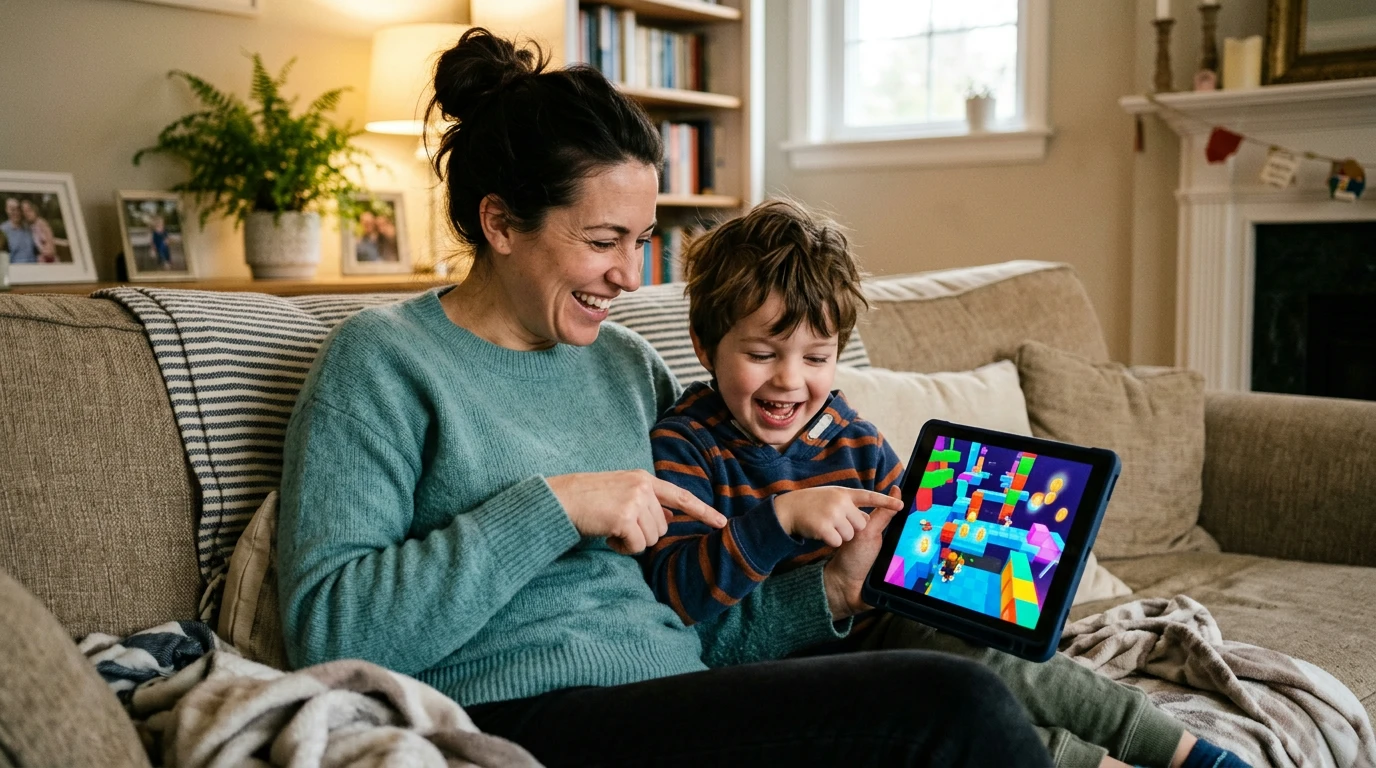
Most of what kids do in Roblox counts as active by that definition. They're choosing a build, failing a jump, adjusting, trying again, negotiating with a friend about what to build next. It's closer to Lego with a screen in front of it than to watching cartoons. That doesn't mean unlimited time is fine. It just means the conversation with your kid should sound less like "get off the screen" and more like "what are you building, can I see?"
Why sitting down and playing beats watching over their shoulder
There's real research behind this, not just a parenting hunch. A study out of the University of Salford on parent-child co-use found that kids learn more, and understand what they're seeing more clearly, when a parent is actually there interpreting it with them, compared to being left alone with it or watched from a distance. Co-play isn't a nice bonus. It's the thing that makes the whole setup safer and more useful.
You don't need to know how to build in Roblox to do this. I don't, and I've still sat next to my own kids while they played. Ask them to show you their favorite obby. Ask them what the scoreboard means, why that one friend keeps inviting them to a specific game, what they'd do if a stranger messaged them. Take turns picking what to play next, even if your pick is clumsy and gets you killed in ten seconds. The goal isn't to get good at the game. It's to be in the room when the interesting stuff happens, so if something weird or uncomfortable comes up, you're already there instead of hearing about it secondhand three days later.
It also sets up an easy family rule that pairs nicely with your screen-time rule: if anyone online, friend or stranger, asks to move the conversation off Roblox and onto a different app or a phone number, that gets reported to a parent immediately. No exceptions, no trouble for saying it. Simple rule, easy to remember, and it covers the real risk better than any setting does.
Here's the part that surprised me
I started paying attention to Roblox because so many kids at our parties talk about it while they're bouncing around or waiting their turn. What I noticed is that the stuff kids love most in Roblox reads almost like a blueprint for a great backyard party. They love obstacle courses with a clear finish line. They love being on a team against another team. They love a scoreboard they can watch update in real time. They love building something and then showing it off to friends.
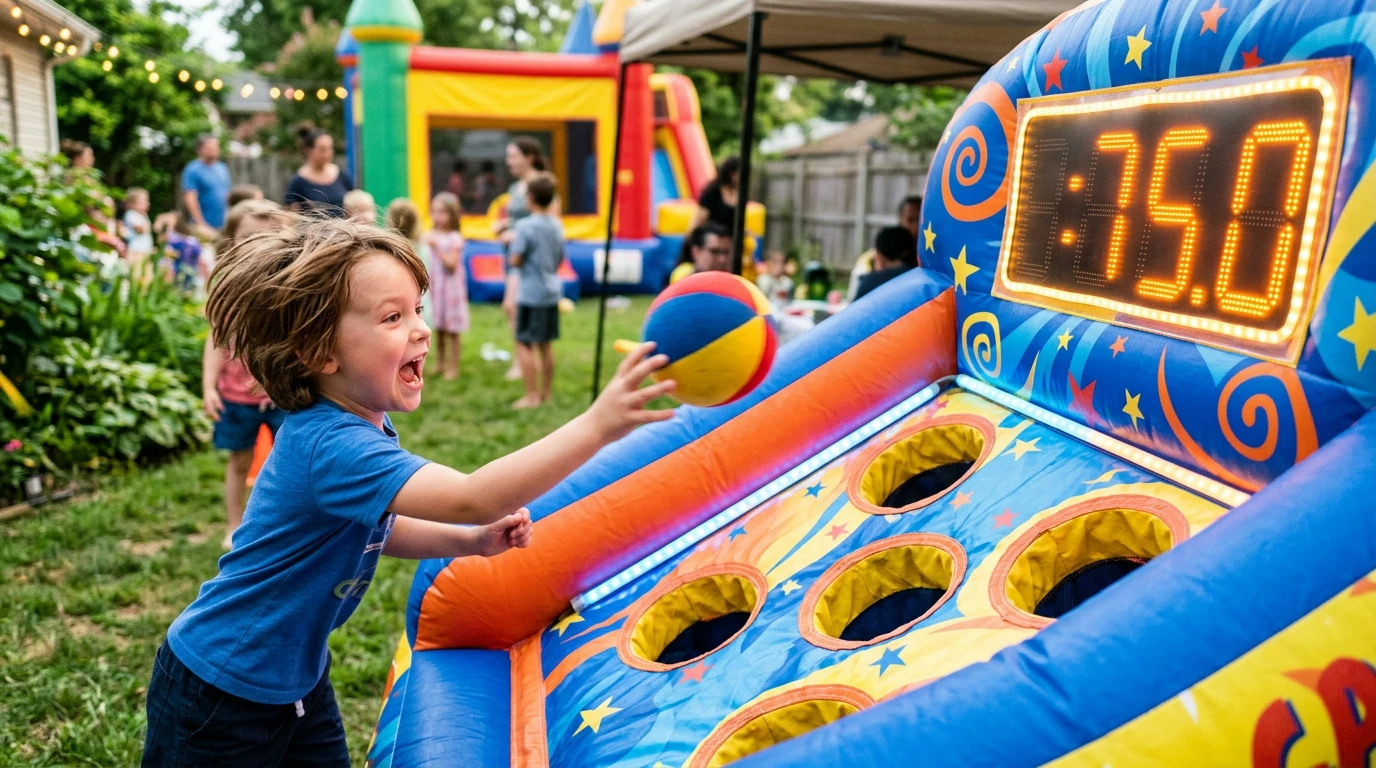
That's not a coincidence, and we're not reading too much into it. Those are just the ingredients of fun for a seven-to-twelve-year-old, whether they show up on a screen or in a backyard. Our sensor-based scoreboard carnival game does exactly what a Roblox minigame does: kids throw, a sensor tracks it, a live scoreboard updates, and suddenly a casual backyard activity turns into a real competition with bragging rights on the line. An inflatable obstacle course is basically a physical obby, minus the respawn button and plus actual exhaustion, which honestly is a win for everyone involved. And if your kid is obsessed with team-battle games, laser tag gives them the same teamwork and competition, but with actual running, actual hiding, and actual high-fives afterward.
If your kid is one of those who spends their Roblox time building elaborate worlds and inviting friends in to explore them, a DIY escape room setup scratches that same itch: a world they built that other people have to figure out. Different medium, same instinct.
Turning screen love into a party plan
Next time your kid is deep in a Roblox session, don't just glance over to make sure they're not talking to strangers. Ask what the game actually is. Ask what they'd build if they could build anything. You'll usually get an answer that sounds a lot like a party theme: an obstacle course, a battle arena, a building challenge with a judge. That's not wasted screen time. That's free party research.
If you're planning their birthday around what you just heard, our guide to planning a stress-free kids party in Montreal walks through timing, space, and age-appropriate activities so the real-world version lands as well as the digital one. And if it's a rainy Saturday and you need an indoor fix before the big day, Montreal's indoor play spots are worth bookmarking too.
The settings matter. Set them up, link your account, don't skip that part. But what actually keeps your kid safe, and makes the whole hobby worth something, is you: sitting next to them, asking questions, occasionally getting smoked in an obby by an 8-year-old. Then, when the controller goes down and the cake comes out, you'll already know exactly what kind of party to throw.
FAQ
Is Roblox one single game?
No, Roblox is a platform hosting millions of user-built experiences, from obstacle courses to shooters to roleplay towns. What your kid is doing inside it matters more than the app name itself.
What do Roblox's age-based accounts actually control?
Roblox Kids (ages 5 to 8) only allows Minimal or Mild rated experiences, Select (9 to 15) opens up Moderate content, and full access requires age verification at 16 and up. Chat is off by default for under 9 and now requires facial age verification to unlock at any age.
Are parental settings enough to keep my kid safe?
Settings are a safeguard, not a substitute. They can block certain content, but they can't tell you if your kid is anxious, being bullied, or chatting with someone who isn't really a friend, only watching or playing alongside them can do that.
Is Roblox bad screen time for my kid?
Not necessarily, since research shows active screen time like building, deciding, and problem-solving tracks with better outcomes than passive screen time like watching videos. Most Roblox play counts as active, closer to Lego with a screen than to watching cartoons.
What's the single most useful thing I can do as a parent?
Sit down and co-play or at least ask questions about what they're building, since research shows kids understand and benefit more when a parent interprets the experience with them. It also puts you right there if something uncomfortable comes up instead of hearing about it days later.
How can I turn my kid's Roblox habits into party ideas?
Pay attention to what they love most, whether it's obstacle courses, team battles, or scoreboards, since those translate directly into real-world activities like inflatable obstacle courses, laser tag, or sensor-based scoreboard games. It's basically free party research happening in your living room.