Inside the Sensor Scoreboard Carnival Game That Turns Backyards Into Mini Competitions
I've set up a lot of bounce houses in a lot of backyards, and there's a moment that happens almost every time. The inflatable goes up, it looks great, the kids pile in, and for about twenty minutes it's pure chaos in the good way. Then, somewhere around the thirty-minute mark, a few kids wander off. Someone's hungry. Someone wants to show their cousin something inside. The energy spreads out instead of staying together.
That's not a knock on bounce houses. They're great, and they do exactly what they're built to do: give kids room to move and burn off energy. But a standard bounce house doesn't give kids a reason to stay focused on the same thing at the same time. There's no shared goal. Nobody's watching from outside because there's nothing to watch.
That's the gap our sensor-based carnival inflatable fills, and it's become one of the pieces of equipment I'm genuinely excited to drop off.
How the scoreboard actually works
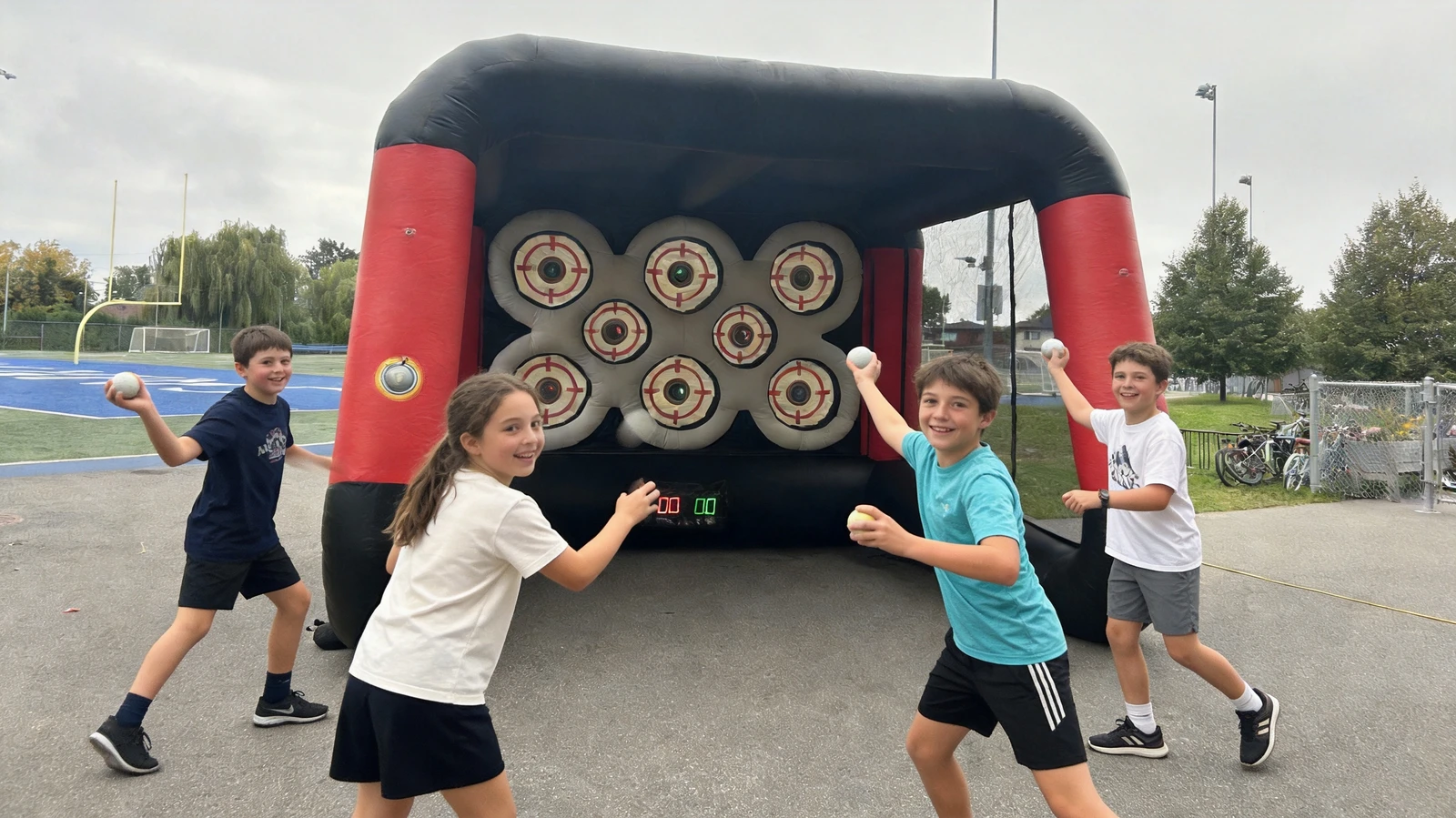
Here's the plain version, no tech talk required. Players throw objects (rings, balls, whatever the specific game uses) at targets built into the inflatable. Each target has a sensor behind it. When something hits, the sensor registers it and the score updates live on a screen attached to the unit. You don't need to keep score on a clipboard, and you don't need to referee who hit what. The game handles that part for you.
Our [Giant Pencils Ring Toss] is a good example of how this plays out in practice. Up to four players can go at once, each aiming at their own set of targets, or everyone can compete for the single highest score. The scoreboard tracks it all in real time, so nobody has to argue about who actually landed that last ring. The game settles it.
That's really the whole mechanism: throw, sensor detects it, score updates. Simple on purpose. The fun isn't in the technology itself, it's in what that technology lets the party do.
The real wow factor isn't the sensors
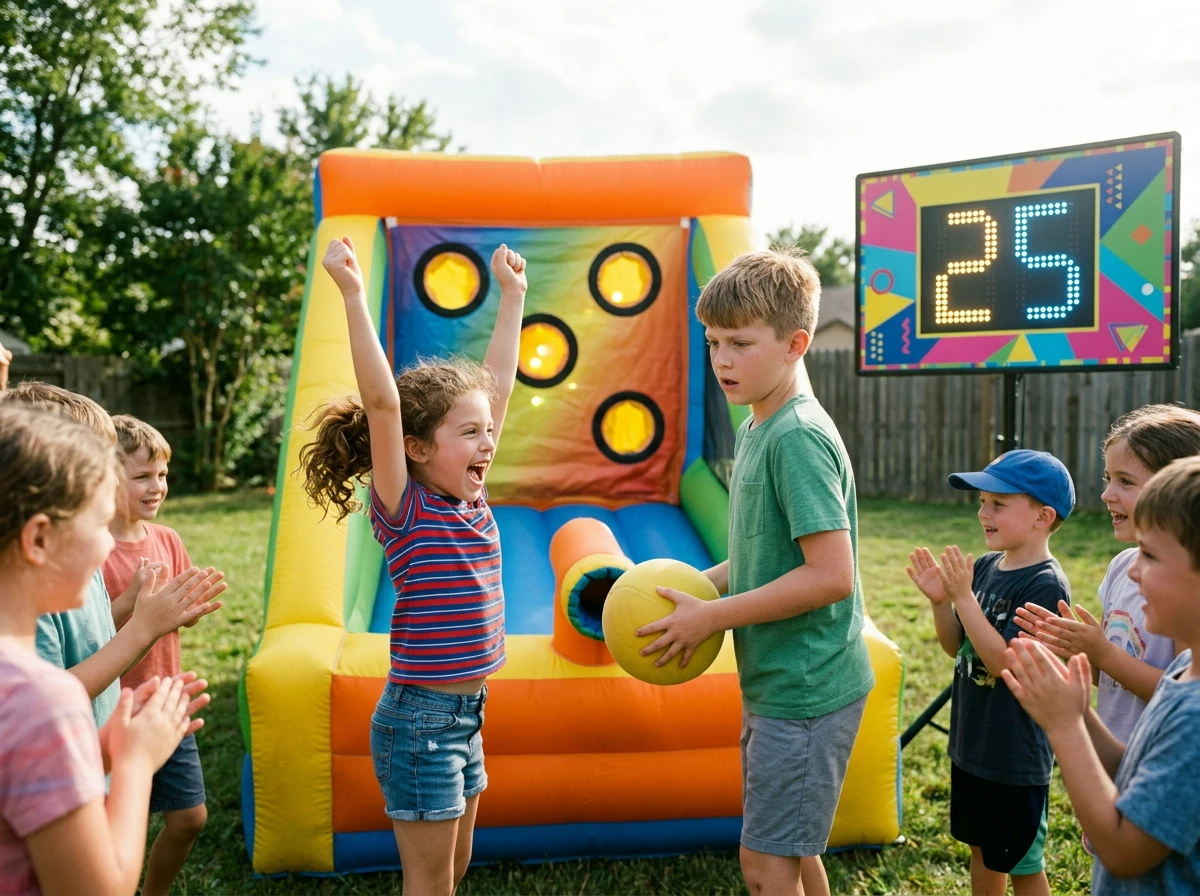
I'll be honest with you: a hidden sensor is not, on its own, an exciting thing. What makes this game land at a party is that the result is visible from outside the inflatable. Anyone standing nearby can watch the number climb, see whose turn it is, and know instantly when someone pulls ahead.
That visibility changes the shape of the party. At a recent setup, I watched two siblings go back and forth on the scoreboard for a solid fifteen minutes, and by round three there were six other kids standing around the outside of the inflatable yelling numbers at them like it was the ninth inning. One kid kept shouting "beat him, beat him!" every time his friend stepped up to throw. Nobody had to organize that. The scoreboard did it by itself, just by being visible and keeping a running total everyone could read.
A regular bounce house can't produce that moment, not because it's a lesser game, but because there's nothing to announce. With a visible score, kids who aren't even playing become part of the action. One inflatable turns into a small crowd event instead of a solo bounce session. That's the difference between kids playing near each other and kids actually playing together, and it's the thing every parent planning birthday party entertainment in Montreal is really hoping for.
It won't fix a party by itself, and that's worth saying honestly
I want to be straight with you here, because I don't like overselling equipment. A scoreboard is not a substitute for a plan. If nobody's managing turns, or the space around the inflatable is too tight for a crowd to gather, or the birthday kid never gets a turn because older cousins keep hogging it, the tech won't save that. Good gear amplifies a good setup. It doesn't replace one.
What I usually tell parents booking an [interactive inflatable game in Montreal] for the first time is to think about flow before the party starts. Who's running turns? Where does the line form? Is it one big free-for-all, or a format with a clear order? None of that is complicated, but deciding it ahead of time is the difference between a scoreboard that creates excitement and one that creates an argument about whose turn it actually is.
The good news is the format is flexible, which is part of why it works for such a wide range of ages and party styles. You can run it as individual high scores, where every kid gets their own tally and bragging rights. You can run it as team totals, which tends to work well for bigger groups or mixed-age birthdays where you want cousins and classmates on the same side instead of head to head. You can time rounds so nobody camps on the game for twenty minutes. Or you can try what I've seen more than one dad pull off: a "beat the host" challenge, where the adult throws first and sets a number for the kids to chase. That one always gets a crowd.
That flexibility is also why these games work just as well at a calmer event, like a school field day, as they do at a loud ten-year-old's birthday. Same equipment, dialed to a different energy level depending on who's playing. We've set the same type of game up for end-of-year school events where the format leans more toward participation than competition, and it works just fine there too.
Why this beats "just another bounce house"
Parents sometimes ask me straight up: is this actually better than a bounce house, or is it just more expensive equipment? Fair question. My honest answer is that it's not better, it's different, and the difference matters depending on what you want out of the party.
A bounce house gives kids open-ended movement. Jump, flip, chase each other, no structure required. That's valuable, especially for younger kids who just need to move. A sensor-based carnival game gives kids a shared objective, a visible score, and an actual declared winner at the end of a round. That structure is what makes it feel like an event instead of just an activity. If you've ever wondered which setup fits your specific party better, I actually broke that comparison down in more detail in our post on choosing between a bounce house, obstacle course, or interactive inflatable, since the right pick really does depend on the age group and the size of your guest list.
For birthdays with a mixed group of ages (siblings, cousins, neighborhood kids who don't all know each other yet), the scoreboard game tends to break the ice faster than free play does. Kids who were standing on the sidelines watching strangers bounce around will walk straight up to a scoreboard and ask how to play. Competition, even light and silly competition, is an easy invitation.
Setting it up right
On our end, these units get anchored and leveled the same careful way we handle every inflatable, with the scoreboard tested before a single kid steps up to throw. General guidance on interactive inflatables, like the kind laid out by Cool Games Inflatables, stresses the same basics we follow on every delivery: secure anchoring, a properly sized play area, and pausing play if the weather turns. None of that changes just because there's a screen involved. If you want a behind-the-scenes look at what our crew actually does on setup morning before guests arrive, that's covered in this post about what happens before the kids show up. And if you're the type of parent who double-checks safety basics before booking anything inflatable, our bouncy castle safety tips post covers the fundamentals worth knowing regardless of which game you pick.
We treat the sensor games as part of our regular rotation alongside bounce houses, slides, and obstacle courses, so booking one works the same simple way as booking anything else from us. If you're planning something low-key, our guide to throwing a stress-free party for an 8-year-old shows how a single great activity, scoreboard game included, can anchor an entire afternoon without you needing a second or third rental to fill time.
If you've got a birthday coming up
The short version: a scoreboard turns one inflatable into something people gather around, not just something kids bounce in and wander away from. It's not magic, and it's not a replacement for a well-run party, but paired with a little planning it gives you one of those moments parents remember long after the cake is gone, the one where the whole yard is yelling over a number on a screen.
If you've got a birthday on the calendar and you're curious whether one of our sensor carnival games fits your space and guest list, reach out and check availability. We'll walk you through which carnival games rental in Montreal option suits your crowd, and we'll have it anchored, tested, and ready before anyone shows up.
FAQ
How does the sensor scoreboard actually work?
Players throw objects like rings or balls at targets with sensors behind them, and each hit updates the score live on a screen attached to the unit. No one has to keep score manually or referee disputes, the game handles it.
How many players can use a game like the Giant Pencils Ring Toss at once?
Up to four players can play at the same time, each aiming at their own set of targets, or everyone can compete for the single highest score.
Is a sensor-based carnival game better than a regular bounce house?
It's not better, just different. A bounce house gives kids open-ended movement, while a scoreboard game adds a shared objective and a visible winner, which makes it feel more like an event.
Will the scoreboard game run itself without any planning?
No, good gear amplifies a good setup but doesn't replace one. You still want to think about who's managing turns, where the line forms, and whether it's a free-for-all or a clear order.
What formats can the scoreboard game be played in?
You can run it as individual high scores, team totals, timed rounds, or even a "beat the host" challenge where an adult sets the number for kids to chase. The format is flexible enough to fit both high-energy birthdays and calmer events like school field days.
What safety steps are taken when setting up these inflatables?
The units get anchored and leveled the same careful way as every inflatable, with the scoreboard tested before kids start playing, following standard guidance like secure anchoring, a properly sized play area, and pausing for weather.